
The Statistics Are Out of This World
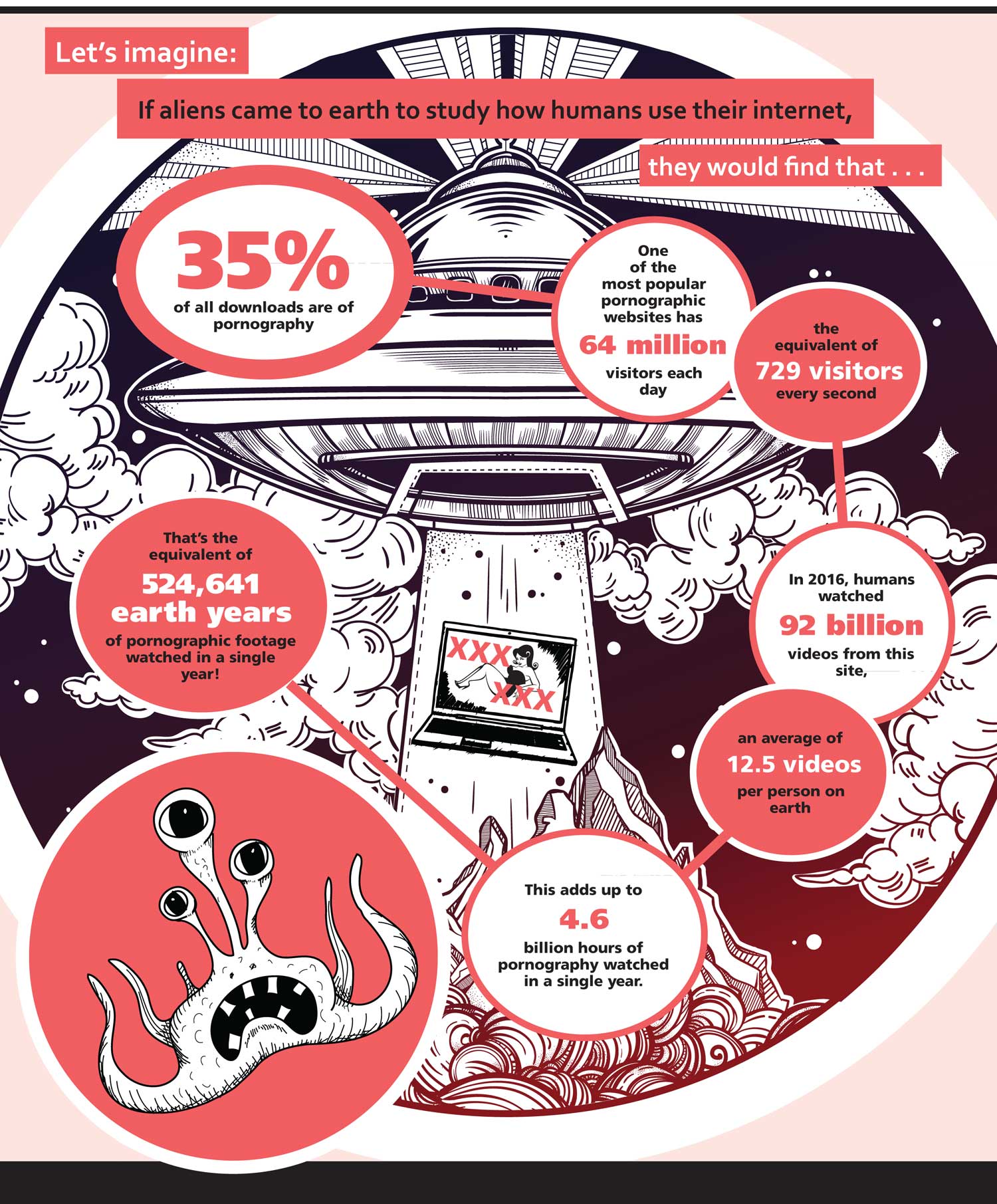
Let's imagine that an alien is visiting earth incognito to study human behavior before sending ambassadors to make the first formal contact with us. One of the first things he notices is that the Internet is an important part of human existence, being used for a wide variety of purposes, including obtaining news and information. But the alien also finds that 35 percent of all downloads are of something called pornography.1
The alien decides to look at some data from the most popular porn website to better understand humans' interactions with pornography. This website, he discovers, receives 64 million visitors each day, the equivalent of 729 visitors every second. During the earth year of 2016, humans watched 92 billion videos from this site, an average of 12.5 videos per person on earth. This adds up to 4.6 billion hours of pornography watched in a single year, the equivalent of 524,641 earth years, or more than 5,000 centuries' worth of pornographic footage.2
The vast majority of the footage shows male aggression toward females in the forms of physical violence and abusive language. Women in their twenties often portray teenage girls in these films, and, sadly, actual children are often featured in porn videos.
When the alien submits his report to his supervisors, what else will it say about humans and pornography?
Economics:3
• Globally, pornography is estimated to be a $97 billion/year industry.
• The U.S. accounts for $12 billion of that total.
• Child pornography is a $3 billion/year industry.
Prevalence (U.S.):4
• Men: 81 percent of teenaged and young adult men have looked at porn, and 67 percent do so monthly. 65 percent of men over 25 have looked for porn, and 47 percent seek it out monthly.
• Women: 56 percent of women under age 25 have looked for porn, with 33 percent doing so monthly. 27 percent of women over age 25 have looked for porn, 12 percent monthly.
• Internet exposure: 71 percent of young adults say they come across porn on the Internet at least once a month, even if they are not looking for it, and almost 50 percent say this happens weekly.
• Messages: 62 percent of teens and young adults have received a sexually explicit image, and 41 percent of this age group have sent one.
Moral Views (U.S.):
• Overall: According to a 2017 Gallup poll, 36 percent of people find pornography morally acceptable.5
• Among the young: According to a Barna study, among teens and young adults, only 32 percent say viewing porn is usually or always wrong.6
• Men versus women: A 2015 Gallup poll found that 43 percent of men thought viewing pornography was morally acceptable, but only 25 percent of women thought so.7
Violence & Escalation:
• Child porn: According to the FBI, one website on the Tor server (used for anonymity) had 1.3 million images depicting children subjected to violent sexual abuse. Another child porn site was found to have 200,000 registered users. This site was accessed 100,000 times during one 12-day period.8
• Abuse of women: In a 2010 study of 50 popular pornography videos, it was discovered that 88 percent of the scenes contained physical violence and 49 percent contained verbal aggression. 95 percent of the victims (mainly women) appeared to have either a neutral or a positive response to the abuse.9
• Personal application: 36 percent of young adults watch pornography for tips on things to try in their own sexual relationships.10
• Escalation to more extreme material: In one study, 49 percent of men who used pornography regularly reported looking at material that they previously either had no interest in or had found disgusting.11
Sexual Dysfunction:
Prior to 2006, erectile dysfunction in men under age 40 was rare. However, several studies show that since 2006, when pornography became widely available online, erectile dysfunction has increased significantly, including in men as young as 18. Such studies indicate that addiction to Internet pornography has the same neurological indicators as drug addiction and that this is probably not unrelated to the fact that pornography addiction strongly correlates with sexual dysfunction.12 On the positive side, it was found that individuals who stopped using pornography as part of their treatment for pornography addiction often found that their sexual dysfunction went away as well.
A survey was conducted in 2014 at the Naval Medical Center in San Diego, primarily among military personnel, to study the incidence of pornography-induced sexual dysfunction among people aged 20 to 40.13 Based on responses from 314 men and 48 women, the study found:
—Men:
• 81 percent viewed pornography at least some of the time.
• 27 percent experienced sexual dysfunction,14 of whom:
—22 percent of men who preferred intercourse to pornography had some sexual dysfunction.
—31 percent of men who used pornography with intercourse reported dysfunction.
—79 percent of men who preferred masturbation with pornography reported having sexual dysfunction.
—Women:
• 38 percent viewed pornography at least some of the time.
• 52 percent experienced sexual dysfunction,15 although no significant correlation was found between their dysfunction and pornography use.
Pervasive & Devastating
In short, our hypothetical alien would find that pornography is pervasive in our culture, and that, even though some say that involvement with it is a personal choice, it has devastating consequences for society.
Heather Zeigerhas an M.S. in chemistry from the University of Texas at Dallas, and an M.A. in bioethics from Trinity International University. She resides in Dallas and currently works as a freelance science writer and educator.
Get Salvo in your inbox! This article originally appeared in Salvo, Issue #43, Winter 2017 Copyright © 2026 Salvo | www.salvomag.com https://salvomag.com/article/salvo43/porn-planet


