
The Big Bang & Christian Cosmology
Before the formulation of the Big Bang theory, it was common for Christianity's opponents to declare that the universe had always existed. In his 1927 essay, "Why I Am Not a Christian," Bertrand Russell explained: "There is no reason why the world should not have always existed. There is no reason to suppose the world had a beginning at all. The idea that things must have a beginning is really due to the poverty of our imagination."1 Nearly fifty years earlier, Robert Ingersoll wrote in Some Mistakes of Moses: "The statement that in the beginning, God created the heavens and the earth, I cannot accept. I think matter must have existed forever. To conceive of a time when neither force nor matter existed is to me utterly impossible."2
This claim was not exclusive to nontheistic opponents of Christianity; Aristotle was a theist who believed in an eternal universe,3 and his influence caused the theory to be widely accepted down through the ages. Yet the twentieth century would see the eternal universe paradigm crumble in a matter of decades, and in its place would reign something few were anticipating: a universe that had a clear beginning, just as the Book of Genesis states.
The story of the Big Bang theory, its personalities and implications, has been told many times. Among the most recent retellings is Stephen Meyer's 2021 book Return of the God Hypothesis: Three Scientific Discoveries That Reveal the Mind Behind the Universe, as well as a 2018 article of his in the Journal of Ideology, titled "Ideology in Physics."
The Big Bang Gains Credibility
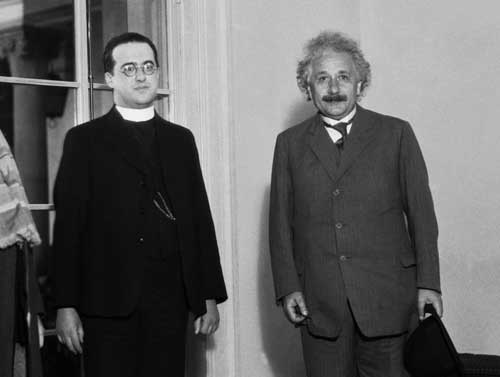
The modern phase of the story begins in 1905, with the publication of Albert Einstein's General Theory of Relativity. After poring over Einstein's equations, the Belgian physicist (and Catholic priest) Georges Lemaître noticed that they seemed to point to a universe that was not static and eternal, but one that was either contracting or expanding. As Anthony Walsh and Marc Ruffinengo of Boise State University explain:
Lemaître reasoned that in a state of past eternity gravity would have long ago pulled all the matter in the universe together into one huge mass. . . . [T]o avoid this crunch the universe had to be expanding, and if it was expanding, it had to do so from a finite point in time. . . . [R]ewinding the cosmic clock we would arrive at a point when all matter was condensed into a single entity, which he called the "primeval atom" or "single quantum."4
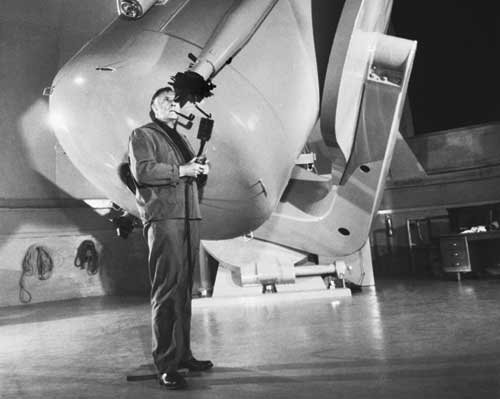
After Einstein's equations, the next major finding that favored the Big Bang came from astronomer Edwin Hubble, who observed the heavens through his state-of-the-art telescopes at Southern California's Mount Wilson Observatory. In 1929, he published a groundbreaking paper titled "A Relation Between Distance and Radial Velocity Among Extra-galactic Nebulae," which concluded, first, that all galaxies are moving farther away from us and from each other, and, second, that the farther away they are, the faster they're moving.5 This strongly complemented Lemaître's opinion that, if we looked far enough back in time, we would see all matter at a single point.
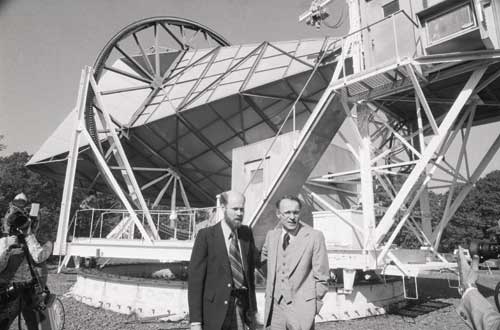
The theory's credibility truly skyrocketed after it passed one of the most demanding tests of all scientific claims: predictive power. Ralph Apher had made the prediction in the late 1940s that cosmic background radiation (CBR) from the expanding universe would be discovered, in more-or-less equal distribution.6 This prediction was confirmed in 1964, when Arno Penzias and Robert Wilson, associated with the Bell Telephone Laboratories in New Jersey, were building a radiation-detecting receiver. The receiver picked up a faint "background noise" everywhere in the sky it was pointed toward, and nothing seemed able to account for it. Researchers from Princeton University who heard about the noise, however, understood it to be CBR, and Penzias and Wilson were subsequently awarded the 1978 Nobel Prize in physics for their efforts.7
Opposition Mounts
During this period of accumulating proofs, the Big Bang theory was fraught with controversy, with objections being raised by people who understood it as a threat to their religion on the one hand, or to their lack thereof on the other.
The term "Big Bang" itself comes from Fred Hoyle, a renowned British astronomer, Royal Society fellow, and secularist. Hoyle came out with the Steady State theory as an alternative to the Big Bang and asserted, "The reason why scientists like the 'big bang' is because they are overshadowed by the Book of Genesis."8 Hermann Nernst, who discovered the Third Law of Thermodynamics, also had a close-minded reaction: "To deny the infinite duration of time would be to betray the very foundations of science."9 Georges Politzer, a hardline devotee of the fashionable and "scientific" Marxist worldview, declared:
The universe was not a created object. If it were, then it would have to be created instantaneously by God and brought into existence from nothing. To admit creation, one has to admit a moment when the universe did not exist, and that something came out of nothingness. This is something to which science cannot accede.10
As late as 1989, John Maddox, editor of Nature and member of the Committee for Skeptical Inquiry, wrote "Down with the Big Bang," slamming it as "philosophically unacceptable. . . . [C]reationists and those of similar persuasions have ample justification in the doctrine."11
A Counter to False Assumptions
For many generations, Westerners have been educated with two assumptions: first, that the ways of science and the ways of religion are irreconcilable, because, according to many influential modern thinkers, the former cares about justifying its claims with evidence, while the latter does not. Second, because of religion's "inferior methods," science was destined to eventually adopt the role of God's undertaker. Galileo's theory of heliocentrism in the seventeenth century and Darwin's theory of evolution by natural selection in the nineteenth are the most commonly cited scientific justifications for the abandonment of traditional religion.
The picture that emerges from the story of the Big Bang is a direct counter to these notions. The Big Bang has profoundly weakened and marginalized the eternal universe assumed by earlier materialists, and the words of the Big Bang's opponents indicate that, for many scientists, secular ideology takes precedence over scientific discovery. Evidence that threatens this ideology is frequently resisted and rejected. Additional discomfort was certainly caused by the fact that chief theorist Lemaître was not only not a secularist, but a Catholic priest! Indeed, some of the reactions from the naysayers cast doubt on the scientific establishment's ability to serve as unblemished guardians of truth. Scientists are apparently like the rest of us mere mortals after all: filled with both virtue and vice, they are human, all too human.
This loyalty to secular ideology, though certainly not universal in the sciences, is common. Biologist Richard Lewontin made a particularly comical (though he was serious) and preposterous defense of secular absolutism in his 1997 review of Carl Sagan's The Demon-Haunted World:
Our willingness to accept scientific claims that are against common sense is the key to an understanding of the real struggle between science and the supernatural. We take the side of science in spite of the patent absurdity of some of its constructs, in spite of its failure to fulfill many of its extravagant promises of health and life, in spite of the tolerance of the scientific community for unsubstantiated just-so stories, because we have a prior commitment, a commitment to materialism. It is not that the methods and institutions of science somehow compel us to accept a material explanation of the phenomenal world, but, on the contrary, that we are forced by our a priori adherence to material causes to create an apparatus of investigation and a set of concepts that produce material explanations, no matter how counter-intuitive, no matter how mystifying to the uninitiated. Moreover, that materialism is absolute, for we cannot allow a Divine Foot in the door.12
One wonders what trump card Lewontin thought he possessed that could warrant that sort of vehement adherence to materialism.
If the universe truly were eternal and uncreated, it would challenge Genesis 1:1 and JudeoChristian thought. Thomas Aquinas's statement that the universe's beginning couldn't be proven turned out to be in error. Also in error was the belief of a certain type of Protestant that the Big Bang theory posed a direct threat to the idea that God created the universe. To the contrary, if the case for the Big Bang had not grown stronger, the case for Christianity—at least from the vantage point of science—would be much weaker than it is today.
Notes
1. Bertrand Russell, Why I Am Not a Christian and Other Essays on Religion and Related Subjects (Touchstone Books, 1957), 7.
2. Robert Ingersoll, Some Mistakes of Moses (Cosimo Classics, 2009), 60.
3. Aristotle, Physics, Book I, Parts 7 and 8.
4. Anthony Walsh and Marc Ruffinengo, "Ideology in Physics: Ontological Naturalism and Theism Confront Big Bang, Cosmic Fine Tuning, and the Multiverse of M-Theory," Journal of Ideology, Vol. 39, No. 1 (Jan. 31, 2018): https://scholarcommons.sc.edu/cgi/viewcontent.cgi?article=1022&context=ji.
5. Neta A. Bahcall, "Hubble's Law and the Expanding Universe," Proceedings of the National Academy of Sciences (March 17, 2015): pnas.org/content/112/11/3173.
6. Elizabeth Howell, "Cosmic Microwave Background: Remnant of the Big Bang," Space.com (April 23, 2018): space.com/33892-cosmic-microwave-background.html.
7. Mike Wall, "Cosmic Anniversary: 'Big Bang Echo' Discovered 50 Years Ago Today," Space.com (May 20, 2014): space.com/25945-cosmic-microwave-background-discovery-50th-anniversary.html.
8. Adam Curtis, "A Mile or Two Off Yarmouth," BBC (Feb. 24, 2012): bbc.co.uk/blogs/adamcurtis/entries/512cde83-3afb-3048-9ece-dba774b10f89.
9. Robert Jastrow, "Have Astronomers Found God?", The New York Times (June 25, 1978): nytimes.com/1978/06/25/archives/have-astronomers-found-god-theologians-are-delighted-that-the.html.
10. Georges Politzer, Principes Fondamenteux De Philosophie (Editions Sociales, 1946/1954), 84.
11. John Maddox, "Down with the Big Bang," Nature (Aug. 10, 1989): nature.com/articles/340425a0.pdf.
12. Richard Lewontin, "Billions and Billions of Demons," New York Review of Books (Jan. 9, 1997): drjbloom.com/Public%20files/Lewontin_Review.htm.
studied film production at Northern Arizona University. He is an independent researcher, freelance writer, musician, and convert to Eastern Orthodoxy. He attends Saint John the Evangelist Orthodox Church in Tempe, Arizona, where he sings in the parish choir.
Get Salvo in your inbox! This article originally appeared in Salvo, Issue #59, Winter 2021 Copyright © 2026 Salvo | www.salvomag.com https://salvomag.com/article/salvo59/science-settled


