
A Review of "Strange New World: How Thinkers and Activists Redefined Identity and Sparked the Sexual Revolution" by Carl Trueman
"[T]he last vestiges of a social imaginary shaped by Christianity are rapidly vanishing, and many of us are even now living as strangers in a strange new world."1 For anyone whose head has not been firmly planted in the blissful sands of ignorance, this observation by Carl Trueman in Strange New World sadly rings true. With the modern West now awash in post-Christian thinking, many are finding themselves in a sea of strange dogmas fueled by the rise of what Trueman calls expressive individualism.
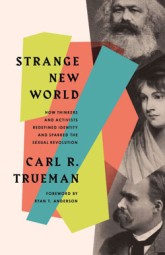
In this pithy but mighty treatise (a shorter, more concise version of his The Rise and Triumph of the Modern Self, reviewed in Salvo 60), Trueman provides insight into how we got to the strange place where we are today. It's a quasi-place, where the authority of the psychological self supersedes that of the most stalwart institutions and even objective biological realities.
In his famous statement, "Man is born free, yet everywhere he is in chains," Jean-Jacques Rousseau decried the "corrupting influence" of society on man's ability to express his true and authentic inner self, notes Trueman.2 To Rousseau, institutions such as marriage, religion, and occupation, as sources of human expectations and obligations, undermine man's ability to be true to his inner feelings.
Trueman briefly chronicles the influence of Rousseau and thinkers who followed, including (but not limited to) Marx, Nietzsche, Freud, and Wilhelm Reich. While rank-and-file adherents of expressive individualism today have likely never read these philosophers, they have nonetheless been influenced by them, as their philosophies have together found expression in the social imaginary.3
Once Rousseau and others erected this idol of the "inner self," Freud entered the picture and sexualized it. Because Freud placed sexual desire as central to human flourishing and identity, sexual desire rose to preeminence and became something of a cultural "intuition,"4 thus entering into the social imaginary. Today, we see this intuition manifested in sexual identity designations; such anachronistic designations as "accountant," "baker," and "teacher," have been replaced with "bisexual," "pansexual," "transgender," and the like. As if these labels were not revolutionary enough, they are now accompanied by a growing lexicon of pronouns. Most strangely, these designations prioritize sexual desires (in the inner psychological space), not sexual acts themselves, as paramount.
Technology-Generated Flux
The tumultuous blending of these redefined identities with advancing technology has generated unprecedented societal flux. No longer do individuals identify and interact with communities based on geography (I'm an American), church affiliation (I'm a Catholic), or even family. Technology now affords community identification with homogenized groups affirming narrow political viewpoints and sexual identities. This has led to unprecedented levels of depression and anxiety in the West.5
While Trueman seems to paint a grim picture, he does offer advice for bewildered believers who find themselves strangers in this uncharted social space. First, we must recognize where we may be embracing the new orthodoxy of expressive individualism—as we may do, for instance, in holding to the seemingly innocuous belief that the Christian life should be a "happy" one—and resist doing so. Second, we can learn from the trials experienced by post-apostolic Christians and find counsel in the writings of Augustine and the apologists. Finally, the Christian should neither despair nor exercise naïve optimism, but rather firm up a theology of the body, embrace the whole counsel of God, and strengthen communal relationships with other believers.6
Notes
1. Crossway, 2022, 169.
2. Ibid., 40, 41.
3. Ibid., 26, 27
4. Ibid, 73, 74.
5. Ibid., 125–127.
6. Ibid., 169–187.
graduated summa cum laude from California State University, Fresno, with a BS in molecular biology and a minor in cognitive psychology. As an undergraduate, she conducted research in immunology, microbiology, behavioral and cognitive psychology, scanning tunneling microscopy and genetics - having published research in the Journal of Experimental Psychology, and projects in scanning tunneling microscopy. Having recently completed an M.Ed. from University of Cincinnati and a Certificate in Apologetics with the Talbot School of Theology at Biola University, Emily is currently an instructional designer/content developer for Moody Bible Institute and teaches organic chemistry and physics. As a former Darwinian evolutionist, Emily now regards the intelligent design arguments more credible than those proffered by Darwinists for explaining the origin of life.
Get Salvo in your inbox! This article originally appeared in Salvo, Issue #61, Summer 2022 Copyright © 2026 Salvo | www.salvomag.com https://salvomag.com/article/salvo61/a-guide-for-the-bewildered-realist


