
The Great Gatsby’s Material World
The Great Gatsby, F. Scott Fitzgerald’s Jazz Age masterpiece, is an indictment of materialism that many have mistaken for a love story. As the protagonist is developed, very different personas emerge. One version is James Gatz, a poor Lutheran farm boy from North Dakota who aspires to self-improvement but drops out of St. Olaf College because he finds working as a janitor to pay his way demeaning. Cheated of an inheritance, he moves east, but before going off to war, he falls in love with Daisy Fay, a Louisville socialite.
Another take is Jay Gatsby, a mysterious resident of Long Island who lives in a mansion where he throws extravagant parties. While his party guests dance, drink, and gossip about his wealth and whether or not he is a bootlegger and a murderer, he remains a silent and sober observer, looking for a single face from the past, the face of Daisy Fay, the idol of his desire, whose approval he hopes to win via his ill-gotten wealth.
Is he Gatz or Gatsby? Or is he the man he professes to be to the narrator, Nick Carraway? Claiming to be the Oxford-educated, orphaned son of a wealthy Midwestern family, Gatsby relates to Nick a tale of touring European capitals, “collecting jewels, chiefly rubies, hunting big game, painting a little, things for myself only, and trying to forget something very sad that had happened to me long ago.” That he identifies his “Midwestern” hometown as San Francisco is only one improbability Nick detects, though even he falls under Gatsby’s alluring spell.
Lives Lived for Self Only
The most telling phrase in his tale, “things for myself only,” points to Gatsby’s materialistic life lived incurvatus in se (“curved in on himself”), a phrase Martin Luther borrowed from St. Augustine to explain what it means to be a sinner. Luther asserts that despite their efforts, apart from Christ, fallen people cannot escape the pull of their own self-interest. None of the characters in this novel even try to escape.
Though Gatsby has acquired his wealth hoping to regain Daisy, he lives a life of appearance without substance. A guest compares Gatsby’s library to a stage set, observing that the books are real but clearly unread. In another scene, Gatsby shows Daisy his collection of imported English shirts. Daisy reacts by saying, “It makes me sad because I’ve never seen such—such beautiful shirts before.” Her adoration is for the things, not the person; for the material, not the spiritual—or even the human.
Nick describes Gatsby as “a son of God” who “must be about His Father’s business, the service of a vast, vulgar, and meretricious beauty.” Though the words evoke Christ, Gatsby’s “Father” is not Christ’s. His guide is not the Holy Spirit but the Spirit of the Age. He aspires to wealth in order to impress a rich young woman who is already married. He makes an idol of her, on which he meditates when gazing at the green dock-light across the bay. Though that light is interpreted as the symbol of his hope to reunite with Daisy, it is also the color of money. The beauty of his mansion is indeed meretricious. Though attractive, it is not quite real in that it possesses no value beyond its opulence. It is not a home.
Moral vacuity is not limited to Gatsby. Daisy is equally shallow. Though typically dressed in white, she is not pure. Because Gatsby was a poor young man, Daisy did not wait for him after the war, but married Tom Buchanan, a wealthy but abusive and adulterous man. Though she may appear to adore Gatsby as much as he adores her, she actually adores aspects of his wealth while simultaneously looking askance at his nouveaux riche taste. Even Gatsby says, “Her voice is full of money.” She regards her daughter as more a possession than a child. Ultimately, she allows Gatsby to suffer for her crime, committed with careless regard for that which is more valuable than any material possession—human life.
A Spiritual Desert
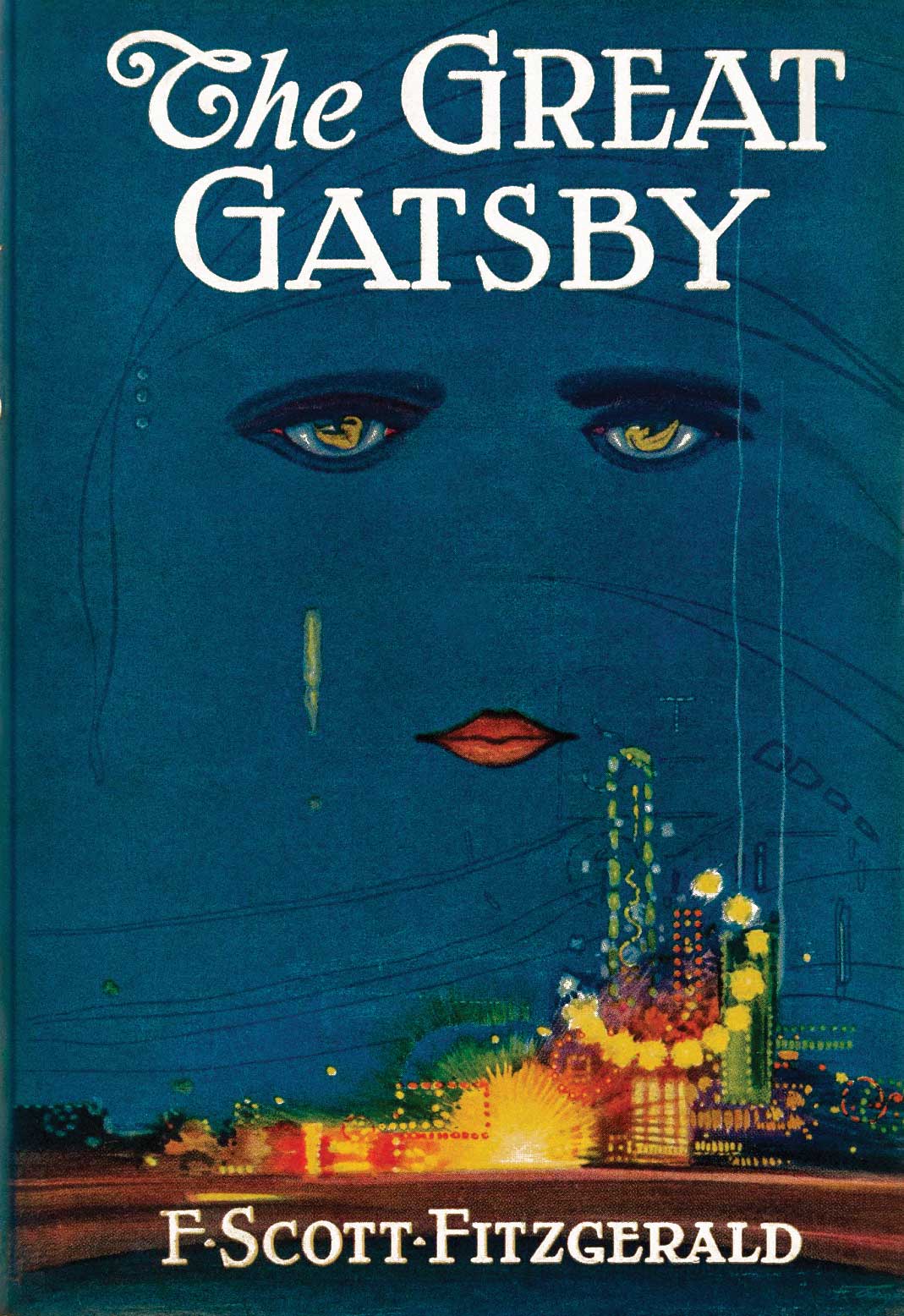
The spiritual desert these characters occupy is best described by the valley of ashes where Tom Buchanan’s mistress, Myrtle, lives with her husband, George Wilson, a decent man who operates a garage and aspires to become a car dealer. Over this desolation bearing witness to the waste of ever-growing materialistic consumption stands Dr. T. J. Eckleburg’s billboard, with its two enormous eyes staring out over the wasteland through gigantic spectacles.
After his wife’s hit-and-run death, those eyes prompt George Wilson to say, “God sees everything.” His friend reminds him that it’s just an advertisement, but the eyes of T. J. Eckleburg are nevertheless a fitting symbol of the absence of God—or an ever-present but unrecognized God—in the lives and thoughts of the main characters, who focus only on the material side of life. Their hedonism and cynicism are their gods.
Fitzgerald the Schoolmaster
What can we learn from reading this book? First, The Great Gatsby is a masterpiece of language. Fitzgerald is a consummate artist. Because he had an ear for conversation, he writes dialogue that sounds natural and, very often, familiar, despite the many decades since his career flourished. If you read this novel once, you may well desire to read it again a few years later, a practice I consistently recommended to my students.
The second reason lies in his development of characters living in a fallen world and overcome by it. Gatsby himself gives in to the whispers of temptation that promise him his heart’s desire. Daisy’s love of her material life trumps the love she should feel for her daughter and explains why she cannot actually love Gatsby. Tom takes what he wants, using his wealth as a tool for conquest and domination. Because of their spiritual emptiness, many of the characters come to unhappy ends, while the survivors appear unaffected and no wiser for having lived the experiences. But these unsatisfying outcomes can be instructive.
Gatsby seems to have begun life well, despite his parents’ poverty. His father tells of his youthful daily routine, which included rising early to exercise and study, of giving eight hours to work, followed by sports and self-improvement. Gatsby recorded his aspirations, which included diligence, reading, saving, and honoring his parents. The glaring absence from his regimen is any spiritual life. He fills that void with a vain pursuit of wealth, imagining he can buy love. The love he desires is a prize, not a gift. His life reflects no concept of love freely given. His story provides opportunities to judge his wisdom in devoting himself to an empty dream.
Yes, Gatsby is something of a love story. But it is a love story devoid of true tenderness, of self-sacrifice. It depicts a love of people as objects, won through the material trappings of wealth: houses, cars, clothes, and hedonistic amusement. In its materialism it is all too contemporary.
F. Scott Fitzgerald asserted, “An author ought to write for the youth of his generation, the critics of the next, and the schoolmasters of ever afterward.” Though Gatsby was no bestseller when first published in 1925, it grew quite popular shortly after its 1949 film adaptation and became a frequent assignment in high-school and college English courses. The novel, once praised for its artistry, has become an opportunity to critique the American Dream, which Fitzgerald treats with cynicism. But contemporary academia’s denigration and denial of that dream is no reason not to read this great book and learn from its characters’ failures.
Rick Reedis a retired secondary teacher of English and philosophy. For forty years he challenged students to dive deep into the classics of the Western canon, to think and write analytically, and to find the cultural constants reflected throughout that literature, art, and thought.
Get Salvo in your inbox! This article originally appeared in Salvo, Issue #64, Spring 2023 Copyright © 2026 Salvo | www.salvomag.com https://salvomag.com/article/salvo64/the-grand-delusion


