
How Ordinary Christians Change the World
In unsettled times, people tend to fall into different camps: reactionaries, revolutionaries, and reformers. Reactionaries flee to the hills, circle the wagons, or start a cult. Revolutionaries demand change now, throwing up barricades in the streets of Paris and eventually chopping off heads. Reformers, though they may appear reactionary or even revolutionary, carry out the patient work of pursuing truth, goodness, and beauty in everything they do. It is reformers who inevitably affect, and eventually transform, societies and cultures, although the observable transformation may be limited to a city, village, neighborhood, or just a circle of friends.
Reactionaries can’t see past the present crisis. They’re stuck in a cycle of reaction. Because they lack a historical perspective, their attempts to put out the fires of radicalism are like the bucket brigades of a bygone era. Their faithfulness and goodwill are not in question. They just need to learn how to use a firehose.
If society and culture were a house, the revolutionaries would want to burn the house down so they could rebuild a Temple to Humanity, a Brave New World, or a Transhumanist Utopia. The revolutionary has all the fire of a religious zealot, convinced of the ultimate truth and value of his revolutionary project. Since revolutionaries don’t believe in God, they summon the almighty power of the next greatest thing in their universe—the government. Revolutionaries are often radical statists. According to Saul Alinsky, Satan was the first radical, and all radical revolutionaries since have served him as their master, whether knowingly or not.
To continue with the metaphor (which I’m borrowing from Idaho pastor Douglas Wilson), while reactionaries are busy with their bucket brigades, and revolutionaries are playing with lighters and gasoline in back alleys, reformers pick up their tools in the endeavor to rebuild the house. The house can be anything—a family, a neighborhood, a church, city, state, or a nation. The reformer does not reject the foundation if it is solid—if it is built on truth, goodness, and beauty. He reinforces the walls. He preserves the best of the ancient building while adding onto and improving it. Here I am using “reformer” to mean anyone who builds on the foundation of the permanent things, the first principles of God’s world, inspired by his natural laws and guided by his Word. In this sense, reformers transcend denominational and sectarian boundaries.
Portraits of Reformers
In chaotic times, we desperately need reformers who will dedicate themselves to the slow, patient work of rebuilding dilapidated communities and institutions. One of the best ways to get started in this important work is to read biographies of reformers of the past, whether famous or forgotten. One resource for the next generation of reformers is The Christian Almanac: A Book of Days Celebrating History’s Most Significant People & Events (2004), by George Grant and Gregory Wilbur, which contains a wealth of historical tidbits and trivia, along with larger biographical sketches and excursions on theology, history, the arts, and culture. It contains numerous portraits of Christians who have labored faithfully in their setting to strengthen the foundation, rather than tear down or burn up the building. The Christian Almanac provides inspiration, motivation, and the larger historical vision needed for the work of reform. I have used it as a textbook for a class in Christian leadership, and it quickly became a daily highlight for many of the families of my students.
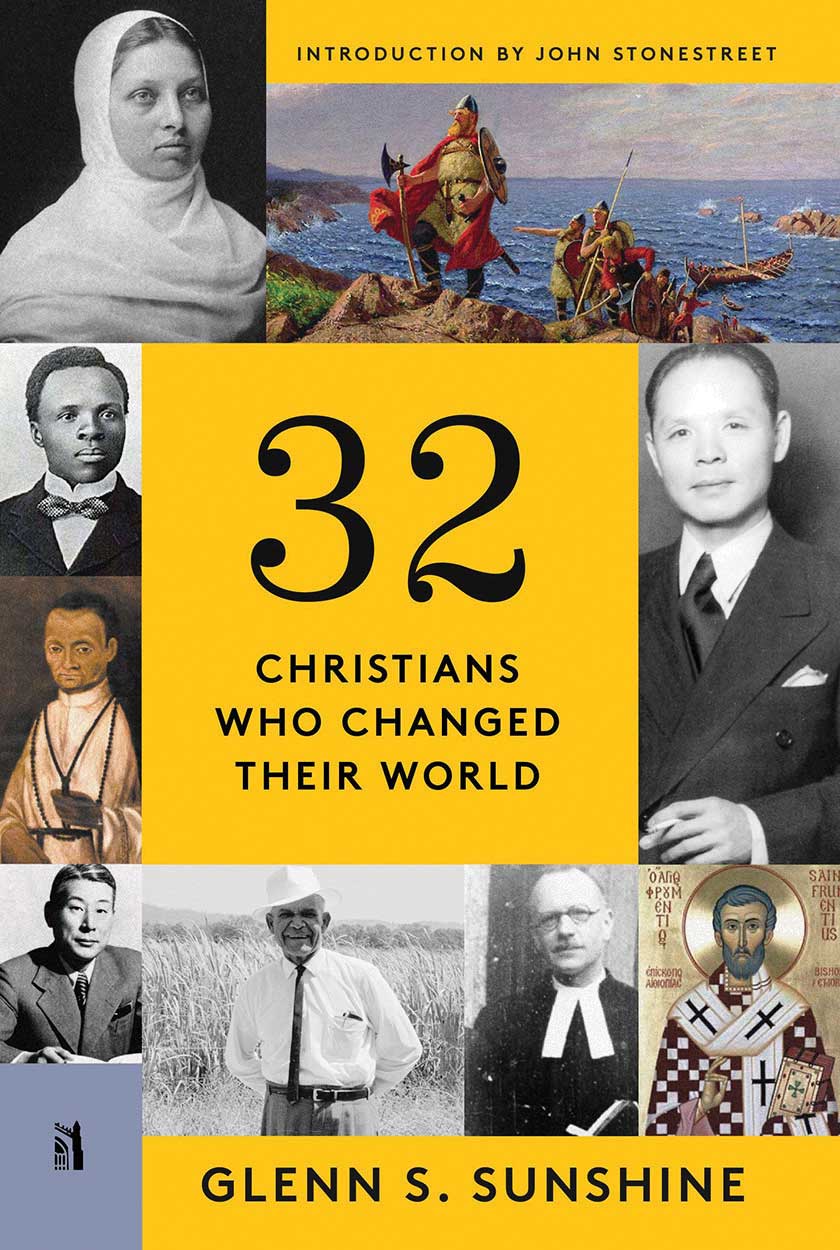
Another resource is Glenn Sunshine’s latest book, 32 Christians Who Changed Their World (2023), which tells the stories of thirty-two reformers who used their skills, abilities, passions, interests, and opportunities to glorify God and change their corners of the world. I am using the term “reformer” loosely. A reformer doesn’t have to be the head of an institution, a famous author, or the leader of a movement. In fact, some of history’s most effective reformers have labored in relative obscurity. Neither the revolutionary nor the reformer is content with the status quo. The difference is in how they pursue change and what they envision as the ultimate goal.
Characteristics of Reformers
So what does a reformer look like? What do reformers do? Here are some commonalities, illustrated with examples from Sunshine’s 32 Christians.
Reformers are catholic—in time and space. Radicals want to begin the world again. Like the French Revolutionaries, they restart the calendar with Year 1—the year of the revolution. Christian reformers recognize that they are part of the church catholic (the universal church). They do not attempt to start from a clean slate. They receive the wisdom of the past and build on the best efforts and achievements of our fathers and mothers in the faith. Some of the names in 32 Christians will be familiar (Leif Ericson and William Carey, for example), some will be less famous (Benjamin Rush and André Trocmé), but most will be new names and stories for many readers.
Sunshine tells the stories of Christians who were faithful in their time and context and had varying degrees of impact but who did not make it into the history books, or at least have been neglected in modern times. This should encourage most of us as we pursue our callings far from the spotlight and media headlines. He includes stories about a wide range of individuals, including women, Africans, Asians, medieval mystics, and more. This catholic (universal) emphasis helps to display the fullness of the grand story God is writing through the faithful labors of his people throughout time and history.
Reformers are often lonely. The work of reformation does not happen overnight, and it often entails struggle, persecution, or even death. We can be encouraged by reading about past reformers and how they navigated their own crises. Whether it is Martin Rinkart (1586–1649) taking care of the dying during a plague, or André and Magda Trocmé and the villagers of Le Chambon-sur-Lignon rescuing and sheltering Jews from the Nazis, Sunshine tells of Christians who did what they believed was right, no matter the cost. Some were recognized and appreciated, and some were soon forgotten. But all were faithful, and all of them impacted our world in important ways.
Reformers reform where they are planted. St. Frumentius and his brother Edesius were missionaries in the 300s to the ancient kingdom of Axum, located in what is now roughly Eritrea and Ethiopia. Although sold into slavery at one point, the brothers were eventually freed, and they influenced King Ezana of Axum, who made Christianity the official religion of his realm, thus making it the “third kingdom to embrace Christianity after Armenia and Rome.” These brothers were faithful, even in slavery, and they helped to create one of the oldest Christian kingdoms in the world. We can also learn from the lives of Christians in the Middle and Far East, like Hunayn ibn Ishaq (808–873), a notable Christian scholar living in a Muslim setting, and Sorghaghtani Beki (1190–1252), who was a Christian queen in the Mongolian empire. Each of these worked within the context in which God had placed them and “bloomed” where they had been planted.
Reformers pursue social justice, biblically defined. They do not pursue the fads of revolutionary, egalitarian “justice.” Instead, reformers have always valued life, education, and mercy because of Christianity’s teachings about the dignity of mankind, the necessity of knowledge, and the importance of modeling God’s love and Christ’s mercy. Black Christians like Octavius Valentine Catto (1839–1871) opposed slavery and participated in a transportation boycott a century before Rosa Parks. Former Hindus like Pandita Ramabai (1858–1922) took care of widows and orphans, and Solomon Tshekisho Plaatje (1876–1932) opposed apartheid in South Africa. Sunshine also introduces readers to Elizabeth of Hungary (1207–1231), who labored for justice and cared for the poor in her kingdom, and Roque González de Santa Cruz (1576–1628), who was a Jesuit missionary to the Guarani people of South America and spoke up for their rights, which were under assault from other political and ecclesiastical sectors.
Reformers realize the strategic importance of education. Education sows the seeds of the future. That is why every revolutionary movement goes after the young, whether it be via the Hitler Youth or drag queen story hours. Accordingly, some of the most effective reformers have focused on education and have influenced countless individuals in the process. Alcuin of York (c. 735–804) brought light into the “dark ages” and helped to spark a rebirth of learning in the early medieval period. Geert Groote (1340–1384) turned away from a life of indulgence and devoted himself to creating communities of Christian laypeople, and they in turn educated many of the next generation of scholars and Protestant and Catholic reformers. In more modern times, educators like James Emman Kwegyir Aggrey (1875–1927) pioneered education in Africa for both men and women.
Reformers can be men or women. A reformer uses his or her God-given abilities, interests, and opportunities to pursue truth, goodness, beauty, and justice. One does not have to sacrifice at the altar of radical feminism to appreciate the multitudes of strong and courageous women who have followed God’s call, even in circumstances that made it more difficult for them as women in a male-dominated world. Marguerite d’Angoulême (1492–1549), who was closely connected to the French royal family, used her influence to encourage and protect those pursuing the reform of the French church. In Strasbourg, Katharina Schütz Zell (1497/8–1562) worked alongside her husband Matthew, writing her own theological works and encouraging those engaged in the Reformation.
Reformers know that all truth is God’s truth, and so they pursue truth in every domain of life. Hildegard von Bingen (1098–1179) experienced mystical visions but also pursued the study of multiple disciplines and was a respected leader throughout Europe. Popes and princes listened to her advice and counsel. Roger Bacon (c. 1214–1292) was a monk and theologian who also laid foundations for what became known as the scientific method, offering a reminder that the “dark” ages were filled with bright points of light.
Reformers work within God-ordained authority structures, but they also obey God rather than men. Like the Hebrew midwives (Ex. 1:18–21) and Peter and the disciples (Acts 6:27–29), reformers serve God—even when it means disobeying a political authority or ruler. Sunshine reacquaints us with forgotten heroes like Chiune Sugihara (1900–1986) and Ho Feng Shan (1901–1997), who used their diplomatic immunity and political connections to write thousands of visas to help Jews escape the Nazis.
A Cloud of Witnesses
In our chaotic times, surrounded by reactionaries and revolutionaries, The Christian Almanac and 32 Christians Who Changed Their World offer us bracing reminders that God uses reformers of all types to accomplish his purposes. The common theme in reformers’ lives is a single-minded dedication to serving God faithfully wherever they are, whatever they are doing, whether it is taking in orphans, teaching and starting schools, studying and writing, or working in the highest levels of government. May those who have gone before us inspire and encourage reformers everywhere.
Gregory SoderbergPhD, teaches and mentors students of all ages at Logos Online School, Kepler Education, the Bible Mesh Institute, and Redemption Seminary. He writes at gregorysoderberg.substack.com and gregorysoderberg.wordpress.com.
Get Salvo in your inbox! This article originally appeared in Salvo, Issue #69, Summer 2024 Copyright © 2026 Salvo | www.salvomag.com https://salvomag.com/article/salvo69/reform-where-youre-planted


