
Alfred Hitchcock’s Foreign Correspondent
When my father did his stint in the Army in the 1950s, he made sergeant and was sent to Germany for a while, which meant that when he got a week’s furlough, he could take a train down to southern Italy, to a little mountain town called Caserta Vecchia. That was where his mother’s people still lived, and we have a couple of photographs from his visit. In 1983, I went there on my own, and I met some of the old folks who remembered my father, including 96-year-old Aunt Rosina, still pottering about her farmhouse, spry enough to make lunch for me and her hardworking son, who was in his 70s.
The American in the Old World
Everybody treated me like a prince, and it wasn’t just because I was kin. I was American. As I traveled up and down through Italy for three months, just a kid with a backpack, I was treated pretty well, and the people would sometimes tell me about their own siblings or cousins who had gone to America to live—though sometimes “America” meant Brazil or Argentina or Canada. People still remembered, with gratitude, the American boys who rooted out the German soldiers from their country, and at great sacrifice too, for the fighting was fierce, especially in Sicily and the south. Those boys came with a certain cheerfulness and youthful confidence, neither blessed nor burdened by the weight of many centuries.
I don’t know that I would now describe America as boyish and brash and willing to go far to save people who long for freedom. Lord knows we have problems that bespeak age and disillusionment: compare the groans and snarls of Taylor Swift with the bright and lively trombone of Glenn Miller, who joined the Air Force in the Second World War to bring music to the soldiers and to cheer their hearts—Major Glenn Miller, that is, whose plane disappeared in a flight over the English Channel.
Hitchcock’s Americans
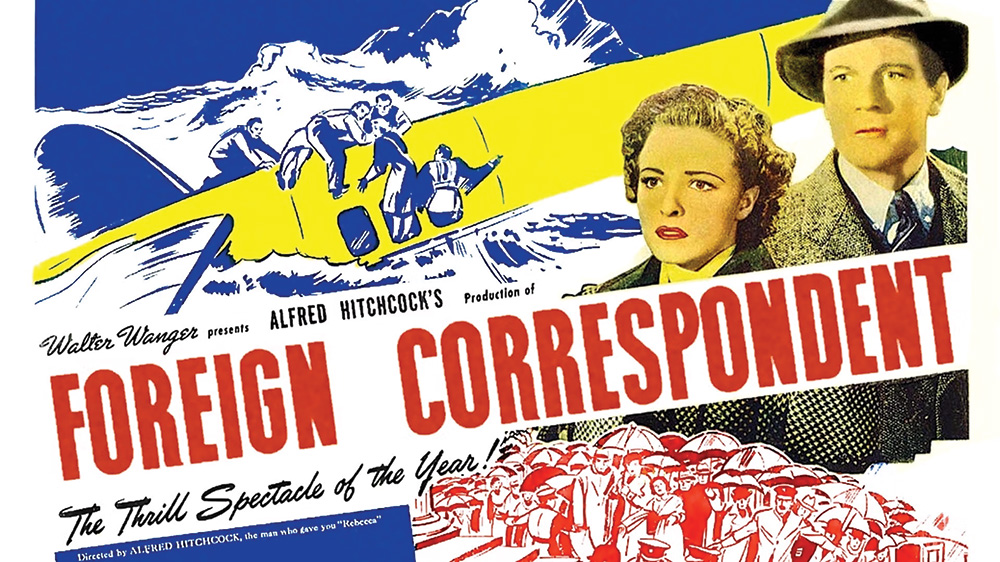
I’ll save the excellent film The Glenn Miller Story for another time; I want now to note that of all the British men who worked in Hollywood, the great Alfred Hitchcock seems to have taken most kindly to America and to that youth and relative innocence and energy. So we find in several of his films that it’s the American, often just somebody who happens to be in the wrong place at the right time, who saves the Old World from itself. They are Americans with no pretensions to high culture, who win out with pluck and dogged adherence to what is right—sometimes, no doubt, with assistance from members of that Old World. They are the Midwestern doctor and his wife on vacation in Morocco, who get embroiled in a ring of espionage and assassination (Jimmy Stewart and Doris Day, in The Man Who Knew Too Much); or an ordinary worker at a munitions plant who is accused of blowing up the factory and who ends up on the run from the police but also determined to ferret out the true pro-Nazi traitors (Robert Cummings in Saboteur); or, for our film here, a straight-arrow reporter sent from New York to get the real scoop on what’s going on in Europe with peace negotiations, just before the onset of the war—Joel McCrea, in Foreign Correspondent.
Wartime Intrigue
John Jones (McCrea), who ends up using the pen name Huntley Haverstock, is supposed to interview an important diplomat in London, but when he meets him, the man is evasive and nervous. He has supposedly taken ill, or at least that is what we hear from the chief of something called the Universal Peace Party. This chief, a man named Fisher, is genteel, soft-spoken, apparently tenderhearted; he is played to perfection by Herbert Marshall, whose countenance and posture speak when words only muddle what an actor is trying to communicate.
Unfortunately, Fisher is a traitor. He is working on behalf of the Germans. It is not that he gains material profit from it, nor is he devoured by an ideology of hatred. He believes he is doing the right thing. Meanwhile, the diplomat is scheduled to appear at a peace conference in Amsterdam, but just as Jones is about to confront him on the stairs of the building where the conference is to be held, the man is shot dead. But the man is an impostor. The real diplomat is not dead—this is what Jones discovers, and the enemies of England want to force out of the old man some critical military or diplomatic secret they are eager to learn, while Jones wants to save the man’s life if possible, or at least to get to that secret first.
To complicate matters, Jones has fallen in love with Fisher’s daughter, Carol (Laraine Day). She believes in her father’s façade, and she does not entirely trust Jones. But a British agent (George Sanders, with his silky-tongued bass, for once in a role as a man of upright courage and decency) is also on the hunt. He does believe Fisher is a traitor, though he needs proof, and of course he wants to unravel and expose Fisher’s scheme. So we end up with an American of peculiarly American goodness, an idealistic young British woman (hardly more than a girl; Miss Day was only 19 when she made the film), and a canny and honest British man, all ranged against the intricate dishonesties of that Old World.
Foreign Correspondent features not one but three of Hitchcock’s best cinematographic coups: one in the groaning and passage-winding works of a Dutch windmill, where evil men have the diplomat hidden and drugged; one in the observation balcony of the dome of Westminster Cathedral, where an amiable assassin (Edmund Gwenn, of all people) seeks to push Jones to his death; and one of the greatest scenes Hitchcock ever managed, in an airplane shot down by a German U-boat and floundering in the North Atlantic, with Jones and Carol and a few survivors clinging to wreckage that can hardly bear their weight. Fisher, discovered for who and what he is, is among them, but not for long.
The Handsome American
The film was made in 1939, and released in 1940, just days before the Battle of Britain. When Jones—having returned to England with Carol at his side and still reporting as Huntley Haverstock—gives the final news flash in this film, it is with bombs exploding in the vicinity and lights going out all over Europe. America had not yet joined the war and would not do so until the Japanese made their fatal mistake at Pearl Harbor, a year after Foreign Correspondent appeared.
“Keep those lights burning,” says Jones, just before darkness descends.
Gary Cooper was offered the role of Jones, but he turned it down, and in Joel McCrea we have a fresh-faced actor, similarly understated, as powerful of build as Cooper was and with that touch of humor that marked Cooper at his best. Cooper was the essential American—in Sergeant York for instance, where he played a mild-mannered convert to the Christian faith, picking off the Germans in a machine-gun nest, just as he once picked off turkeys back in Appalachia. McCrea, one of the straight and pure souls in Hollywood, a man of faith, married only once (to the actress Frances Dee, for 57 years, till his death in 1990), was in his manners and his personal life more like the characters that Cooper played than Cooper himself was.
I believe that Hitchcock saw it, too, and appreciated the dramatic possibility of straight common sense and intelligence, combined with innocence in its manly shape. Will we see another Joel McCrea in Hollywood again? I don’t think so, but in the grace of the great Director from on high, all things are possible.
Anthony EsolenPhD, is a Distinguished Professor at Thales College and the author of over thirty books and many articles in both scholarly and general interest journals. A senior editor of Touchstone: A Journal of Mere Christianity, Dr. Esolen is known for his elegant essays on the faith and for his clear social commentaries. In addition to Salvo, his articles appear regularly in Touchstone, Crisis, First Things, Inside the Vatican, Public Discourse, Magnificat, Chronicles and in his own online literary magazine, Word & Song.
Get Salvo in your inbox! This article originally appeared in Salvo, Issue #71, Winter 2024 Copyright © 2026 Salvo | www.salvomag.com https://salvomag.com/article/salvo71/american-lights


