
James Webb Space Telescope Affirms Creation
The James Webb Space Telescope (JWST) was designed and launched to fulfill one primary mission above all else: to “boldly go where no man has gone before.” In other words, it was sent to explore the “cosmic dawn,” the moment when starlight first illuminated the universe. This moment, according to big bang models, extends from about 180–700 million years after the cosmic creation event.
To observe the cosmic dawn, astronomers must probe whatever they can detect at a distance of many billions of light-years. Remember: due to the finite and unchanging velocity of light, distance means time. So the farther away we look, the farther back in time we are seeing the condition of the universe. Also keep in mind that due to the expansion of the universe, the most distant objects are moving away from us at increasing speed. The visible light of objects at distances corresponding to the cosmic dawn era (13.1–13.6 billion light-years away) will be shifted into the infrared part of the electromagnetic spectrum. For this reason, astronomers designed the JWST specifically to detect infrared radiation.
Bright Early Galaxies
Astronomers met with a big surprise when the JWST detected several bright galaxies in the cosmic dawn, galaxies with ultraviolet luminosities as much as ten times brighter than what standard big bang models had seemed to allow.1 However, these models assumed that star formation during the cosmic dawn proceeded at a constant rate. Follow-up observations affirmed that star formation was just as stochastic, or “bursty,” during the cosmic dawn era as during the subsequent 13 billion years. Once astronomers took into account the burstiness of cosmic dawn star formation, they realized that the ultraviolet luminosities they observed were entirely compatible with standard big bang models.2
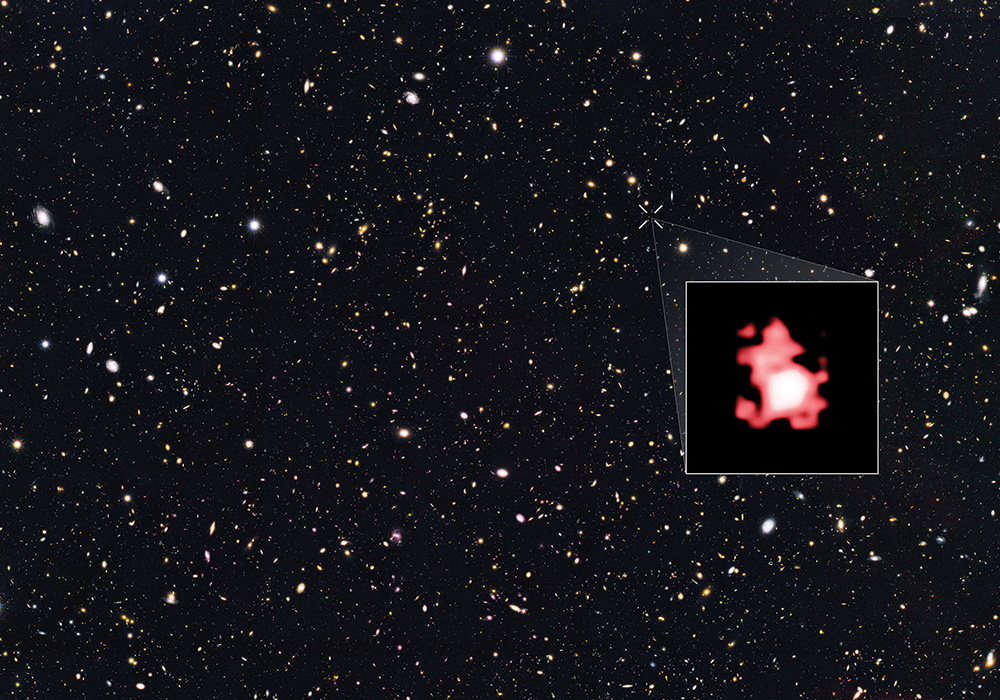
GN-z11 Galaxy
Even before the launch of the JWST, the Hubble Space Telescope had detected a cosmic dawn galaxy, GN-z11 (figure 1). It appeared much brighter than anticipated, despite being the most distant galaxy researchers had yet discovered.
In September 2023, a team of 63 astronomers used the JWST’s near-infrared spectrometer to measure GN-z11’s redshift,3 calculated at 10.603. This measurement tells us that GN-z11 is 13.38 billion light-years from Earth—a distance that means we’re seeing GN-z11 just 410 million years after the initial moment of cosmic creation. This finding seems astounding, given that star formation is not even possible until the universe is at least 180 million years old.
GN-z11 is not the only exceptionally luminous galaxy found in the cosmic dawn. Images taken by the JWST reveal several dozen others. These discoveries immediately spawned numerous popular media articles—many claiming the big bang is wrong or at least needs major revision. Some went so far as to suggest that scientists may be on the verge of discovering some radically new physics.
Why Such Brightness?
While no astronomer publishing in peer-reviewed astrophysical journals has called for an abandonment or replacement of big bang models, a few have advocated for “a reexamination of the theoretical landscape of galaxy formation at cosmic dawn.”4 To determine whether such a reexamination is needed, 36 astronomers led by Roberto Maiolino undertook a detailed probe of GN-z11.
Using both JWST’s near-infrared spectrometer and its near-infrared camera,5 Maiolino’s team discovered a huge clump of gas in GN-z11’s halo, about 7,800 light-years from its core. The camera revealed that this clump was powerfully illuminated by stars in its core region, so brightly illuminated that its gas had been ionized. The spectrometer revealed the clump’s elemental composition: hydrogen and helium, with no elements heavier than helium.
The lack of any elements heavier than helium in the gas clump provided, for the first time, direct evidence confirming a major prediction of all big bang models. These models state that the universe begins infinitesimally small, nearly infinitely hot, and with just one element—hydrogen. Between three and four minutes after the cosmic beginning, they predict, the expanding and cooling universe passes through the temperature window at which hydrogen can fuse into helium. About a quarter of the primordial hydrogen (by mass) becomes fused into helium, along with a trace amount of lithium. All other elements are manufactured later in the nuclear furnaces of future stars. Maiolino’s team was the first ever to see a gas cloud that contained only the elements produced in the initial “bang.”
To explain the level of ionization observed in the gas clump, Maiolino and his colleagues calculated that the combined brightness of the stars illuminating the gas clump was equivalent to at least 20 trillion times our Sun’s luminosity. This high luminosity can be explained only if the stars in the core of GN-z11 are extremely massive. Based on the gas clump’s spectra, the team determined that the ionizing radiation came not from the supermassive black hole in the galaxy’s core but, rather, from stars in that core.
In the context of big bang models, astronomers had developed predictions for how massive the universe’s first stars—stars that begin with 75 percent hydrogen, 25 percent helium, and a trace amount of lithium—would likely be. They anticipated some will range from 1–100 solar masses, others from 1–500 solar masses, and still others from 50–500 solar masses, with the possibility that some of the first stars could be as massive as 1,000 solar masses.6
The gas clump spectra taken by the JWST show that the stars illuminating the clump are, indeed, the universe’s first-formed stars. Further, the spectra show that these stars are predominantly in the 50–500 solar masses category, with a significant fraction greater than 500 solar masses.
A star’s luminosity rises exponentially (to the 3.9 power) with its mass. A star 200 times the Sun’s mass will be ~1.6 trillion times brighter. A star 500 times more massive than the Sun will be about 6 trillion times brighter! Therefore, even if the GN-z11 core contains only 20,000 stars, the light from those stars would be more than sufficient to illuminate the gas clump to the degree that Maiolino’s team observed. Given that all big bang models predict the formation of 20,000+ metal-free stars (stars with no elements heavier than helium, other than a trace amount of lithium) in multiple galaxies during the cosmic dawn, the population of bright galaxies observed by the JWST in no way challenges standard big bang creation models.
Early Supermassive Black Holes
Maiolino and his team found a second luminosity source in GN-z11.7 They observed a dense flow of gas into the GN-z11 nucleus. In this gas they detected ionized elements clearly showing the existence of a giant black hole, one aggressively accreting matter. These observations enabled the team to calculate the black hole’s mass. That mass measures two million times our Sun’s mass.
The event horizon around a black hole is a location at which the black hole’s gravitational attraction is so strong that not even light can escape it. Consequently, everything inside the event horizon appears black, while just outside the event horizon, matter is being converted into energy with 10–42 percent efficiency—the highest efficiency of any source in the universe (see figure 2). By comparison, this efficiency is 150–600 times greater than the matter-to-energy conversion in the Sun’s nuclear fusion furnace.
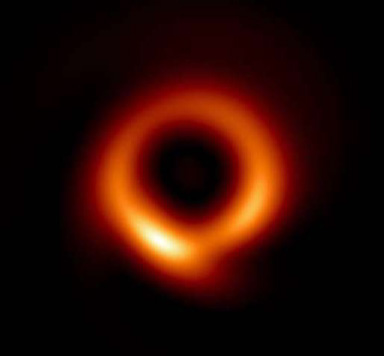
The black hole in the GN-z11 nucleus is the most distant supermassive black hole (SMBH) discovered to date. (By definition, an SMBH is a black hole more than a million times the Sun’s mass.) The presence of this ravenous SMBH and the brightness of first-formed stars in GN-z11 explain its luminosity, which is entirely consistent with standard LCDM big bang creation models (where L stands for dark energy—the primary component of the universe—and CDM for cold dark matter—the second most dominant component of the universe).
Maiolino and his colleagues have confirmed that the first stars to form in the universe are likely very massive. They’ve also demonstrated that a dense clump of very massive stars in a cosmic dawn galaxy has a high probability of forming an SMBH. Therefore, it is not surprising that astronomers will find many bright galaxies with SMBHs in the cosmic dawn. The claim that the big bang model needs a major revision or points to new physics now appears to have been nullified.
Theological Implications
For thousands of years, the Bible has stood alone in describing several of the fundamental features of the big bang.8 No other cosmic origin model has been subjected to as many rigorous and independent tests as the big bang.9 Thanks to the power of the JWST and the research efforts of Maiolino and his team, the big bang has passed yet another set of tests.
The success of these efforts provides still greater evidence to support the biblical claim that a Causal Agent beyond space and time created our universe and exquisitely designed it so that billions of humans can reside on our planet and develop a technologically advanced civilization. Their success also confirms the Bible’s power to predict, accurately, future scientific discoveries. This power affirms the supernatural inspiration and accuracy of the Bible, with its assurance of God’s desire and capacity to redeem fallen (as in self-serving, self-exalting) humanity.10
Notes
1. Guochao Sun et al., “Bursty Star Formation Naturally Explains the Abundance of Bright Galaxies at Cosmic Dawn,” The Astrophysical Journal Letters 955, no. 2 (October 1, 2023): id. L35.
2. Hugh Ross, “Big Bang Model Is Not Dead,” Today’s New Reason to Believe (blog), Reasons to Believe (January 1, 2024).
3. Andrew J. Bunker et al., “JADES NIRSpec Spectroscopy of GN-z11: Lyman-a Emission and Possible Enhanced Nitrogen Abundance in a z = 10.60 Luminous Galaxy,” Astronomy & Astrophysics 677 (September 2023): id. A88.
4. Sun et al., “Bursty Star Formation Naturally Explains,” p. 1.
5. Roberto Maiolino et al., “JWST-JADES. Possible Population III Signatures at z = 10.6 in the Halo of GN-z11,” Astronomy & Astrophysics 687 (July 2024): id. A67.
6. Kimihiko Nakajima and Roberto Maiolino, “Diagnostics for PopIII Galaxies and Direct Collapse Black Holes in the Early Universe,” Monthly Notices of the Royal Astronomical Society 513, no. 4 (July 2022): 5134–5147.
7. Roberto Maiolino et al., “A Small and Vigorous Black Hole in the Early Universe,” Nature 627 (January 17, 2024), 59–63.
8. Hugh Ross, “What Does the Bible Say About the Big Bang?” Today’s New Reason to Believe (blog), Reasons to Believe (February 6, 2023).
9. Hugh Ross, “Big Bang Model Is Not Dead”; Hugh Ross, “Cosmic Dawn Evidence Bolsters Case for Creation,” Today’s New Reason to Believe (blog), Reasons to Believe (July 10, 2023); Hugh Ross, The Creator and the Cosmos, 4th ed. (RTB Press, 2018).
10. Hugh Ross, Rescuing Inerrancy: A Scientific Defense (RTB Press, 2024).
PhD, is an astrophysicist and the founder and president of the science-faith think tank Reasons to Believe (RTB).
Get Salvo in your inbox! This article originally appeared in Salvo, Issue #71, Winter 2024 Copyright © 2026 Salvo | www.salvomag.com https://salvomag.com/article/salvo71/in-the-beginning-2


