
A Modern Look at an Ancient Event
No other story in the Bible generates more controversy—among skeptics and believers—than the Genesis account of Noah and the flood. Many people fail to realize that Genesis is not the only biblical reference to this cataclysmic event. Job, Psalms, Proverbs, Hebrews, and 2 Peter also make specific reference to it and to its significance. A careful integration of overlooked contextual clues (in Genesis) with these other biblical passages relevant to the flood, alongside a growing body of research about our planet’s terrestrial history, contributes to a plausible case for the story’s veracity.
The two predominant views of Noah’s flood among Christians are (1) that the flood was global in extent and responsible for nearly all of Earth’s geological features and fossils and (2) that the flood was local, impacting only a single region on Earth’s surface and wiping out only a fraction of Earth’s life and human population. Both views face problematic biblical and scientific challenges. A view that avoids these challenges is that of a “worldwide” flood. A worldwide flood is one where the entire “world” of ungodly people is wiped out (2 Peter 2:5), along with all the animals associated with it, i.e., those animals in personal contact with ungodly people.
In other words, the seemingly audacious claim that this Genesis story is literally true, as well as figuratively significant, is eminently defensible, both biblically and scientifically.1 From the standpoint of both Earth and human history, the flood could have been, and would have been, a “worldwide” event, even if it had not been “global” in extent.
Just as amazingly, the flood proves to have been beneficial in multiple ways, in addition to ensuring the persistence and advancement of human civilization. In the limited space of an article, only a few of the material and spiritual benefits can be addressed, but they warrant recognition and appreciation. Ultimately, the flood enhanced multiple ecosystems, fostered human well-being, and nurtured the eventual launch and sustenance of global civilization.
Enhancement of Earth’s Surface Conditions
According to Genesis chapter eight, the floodwaters took nearly a year to fully recede. The floodwaters would have needed such a long time to flow out into the oceans only if the initial floodwaters from the 40 days and nights of torrential rain, along with the water uplifted from underground aquifers (Genesis 7:11–12), were being replaced by an enormous quantity of melting ice and snow. While no such huge amount of rapid ice- and snowmelt has occurred since the close of the latest ice age (when ice covered 23 percent of Earth’s surface), researchers know of more than a dozen episodes during the previous ice age when massive rapid melt events occurred. The figure below shows that from 77,000 to 15,000 years ago, the global mean temperature quickly rose by about 8°C more than a dozen times, causing hundreds of feet of ice thickness to rapidly melt away from relevant ice sheets each time. So instead of the floodwaters flowing out into the oceans within just a few weeks, the recession of Noah’s flood took almost a year.
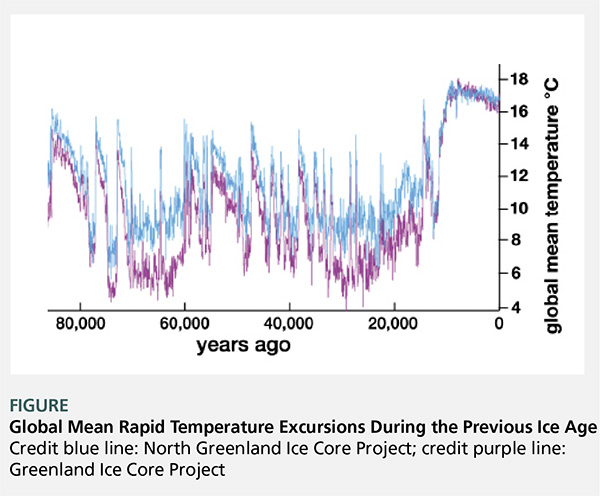
The runoff of rain, melting snow, and ice from mountains and hills surrounding the Near- and Middle-Eastern regions deposited vast quantities of soil nutrients. This massive fertilization event would have been accompanied by another event. Whenever thick ice sheets melt, the crust beneath them rebounds from having been compressed by their heavy weight. This rebounding action, in turn, gives rise to widespread volcanic activity, further contributing essential nutrients to Earth’s soil.2
The fertilization of agricultural plains nearly all over the world would help explain, at least in part, how Noah’s descendants were able to relaunch civilization as quickly and aggressively as they did. Such a relaunch would have set the stage not only for rapid population growth but also for the well-documented spread of humanity to previously uninhabited parts of the globe. Finally, humanity could make progress in fulfilling God’s original assignment (Genesis 1:26–30) to multiply, fill the earth, and wisely manage its resources to meet all life’s needs.
The timing of Noah’s flood also appears providential. To spread out over the whole planet, people required passage from one major land mass to others. We now know that land bridges—for a limited time, only—connected Earth’s continents to each other and to large islands. To facilitate human migration and settlement of Earth’s continents (Genesis 10–11), these bridges had to match people’s requirements with regard to tolerable climate, navigable terrain, and nutritional support from flora and fauna. However, even after the flood, humanity required a supernatural “nudge” (at Babel) to spread outward before those connectors became submerged. Recent research confirms that several just-right land bridges allowed human migration into southern Europe, northern Europe, all of eastern Asia, Australia, New Guinea, and Tasmania—both rapidly and nearly simultaneously. Human remains and genetic studies, along with artifacts associated with anatomically modern humans and food preparation and cooking evidence, establish that these regions were first settled by humans simultaneously 40,000–50,000 years ago,3 implying that Noah’s flood occurred previously.
It seems possible, even likely, that Earth benefited in even more ways from the timing and location of a massive flood event. Nevertheless, because the flood occurred during an ice age—likely the latest one in the ongoing ice age cycle—the geological and archaeological evidence of it would have been eradicated by repeated melting and reforming of ice sheets, as well as by accompanying erosion and volcanic activity. Researchers can only hope ongoing investigation will tell us more.
Protection from the Human Condition
We may wonder why the human population grew and spread out so recently (in just tens of thousands of years), developing language, civilization, and culture in this same recent time frame. Many physical reasons can be and have been offered, but the snapshot of early humanity provided in the early chapters of Genesis offers helpful spiritual insight.
People today, and in centuries past, tend to minimize the gravity of what the Bible identifies as “sin” and the weight of its damage to our relationships—with God, ourselves, other people, other creatures, and our planet. The biblical testament to the human condition from the time of Adam and Eve to the time of Noah provides a vivid picture of the consequences of failing to restrain self-centeredness and the impulses it engenders. Murder occurred right away and spread quickly. Not long after Cain killed his brother Abel, Lamech boasted about murdering seven men in retaliation for an insult or injury.
These early stories make clear why God commanded Noah and his family, after their survival and return to land, to deal swiftly and justly with murder. In Genesis 9:5–6, we read God’s emphatic statement that murder must not be tolerated. Human authority structures must do whatever is necessary to restrain unjust killing. God reminds Noah and his family that every human being bears God’s likeness and embodies immeasurable worth. Thus, in addition to restraining murder, human authorities must do everything within their power to ensure each person is treated with appropriate dignity and respect.
A marked shortening of the human lifespan after the flood underscores humanity’s need for supernatural help in restraining evil. As we see in the Genesis chapters leading up to the flood story, a lifespan of hundreds of years, which people tend to think would be wonderful, was shown to cause more harm than good. I will not argue here for the scientific plausibility of such lifespans prior to Noah’s time because the issue is addressed elsewhere in my writing.4 I will say that in view of our moral weakness, human life spans of extreme length appear to facilitate the spread of evil. A maximum lifespan of about 120 years seems sufficient for us to decide who or what we will devote ourselves to serving—now and in the life to come. Jesus clearly demonstrated the reality of life beyond the limits of our earthly existence.
Genesis 6:4 reports that “the Nephilim were on the earth in those days [the days before the flood]—and also afterward.” The Hebrew word Nephilim means “fallen ones.” According to various Bible passages,5 these beings of towering stature and great strength (also known as the sons of Rapha, the Rephaim, sons of Anak, Anakites, Anakim, giants, or heroes of old) are depicted as thoroughly evil, a threat to humanity’s survival.
For this article’s purposes, it seems sufficient to note that the exceptional wickedness and prowess of these beings made them super-spreaders of reprehensible evil. Genesis chapters 6–9, 18–19, and Romans chapter one emphasize how evil tends to metastasize like a malignant tumor. Noah’s flood destroyed the first Nephilim, but then another generation arose. So God raised up Moses, Joshua, then David and David’s “mighty men” to wipe them out for good.
The flood served as part of God’s plan to prevent humanity’s extermination. When our extinction appeared imminent, other life-forms were also at risk. The nephesh (soulish) animals in close contact with humans were subject to irreparable damage from their exposure to extreme human evil. Human depravity can impact even our animals. In this context, Noah’s flood can be seen as a severely merciful rescue operation.
The biblical account of humanity’s long-delayed spread from a single region of Earth (Genesis 6–11) leads up to the story of Abraham and of God’s covenant through him to us (Genesis 11–15 and beyond). Christian scholars throughout church history have recognized and taught the spiritual significance of the Genesis flood story. It foreshadows the gospel message, God’s gift of redemption by grace through faith. It also foreshadows the symbolism of baptism, the spiritual “immersion” of believers into an eternal, redemptive relationship with our Creator.
Virtually all Old Testament narratives, while historically reliable, also provide a preview, an unmistakable portrayal, of Jesus Christ’s future work. They show us how people who chose to put their trust in God were rescued from bondage to sin and death and granted eternal fellowship with the Father, Son, and Holy Spirit. Of all the Old Testament stories, this account of Noah and his family’s (and their animals’) rescue by God’s gracious provision provides one of the clearest and most dramatic depictions of the gospel.
The Flood’s Most Important Lesson
The story of Noah’s flood is known—in one form or another—among virtually all the cultures and people groups of the world. For example, in the ancient cultures of North and South America alone, about 300 flood legends and stories existed.6 Even in their distorted forms, these stories and legends raise questions about the human condition. The meaning and significance of the flood are available for all to ponder.
Water serves as a powerful symbol in the Bible. In bringing God’s judgment upon evil, it brings salvation to his people. From beginning to end, God’s redemption story portrays the Spirit of God as life-giving water. In Revelation 22:1–2, we see water, “clear as crystal, flowing from the throne of God and of the Lamb, down the middle of the great street of the city,” the holy and eternal city of God.
Those of us who have access to the Scriptures have good reasons to trust that the biblical account of Noah’s flood is literally and historically defensible. By showing it to be true, we remove a major challenge to biblical reliability that has become for many a stumbling block to faith. The door is open for Bible readers to affirm that everything written in the sixty-six books on all topics addressed has been supernaturally inspired by God.7
Confidence that the Bible is, indeed, the true and trustworthy Word of God provides powerful motivation to consider what its stories, including the account of Noah and the flood, reveal about God’s heart. Just as God reached out with precise timing and a perfect plan to rescue Noah and his family from sin’s encroaching malignancy, so God reaches out with precise timing and a perfect plan to rescue all who put their trust in him through Jesus Christ—God’s Son, our Creator and Redeemer.
Notes
1. Hugh Ross, Noah’s Flood Revisited: New Depths of Insight from Science and Scripture (2025).
2. Dhongil Lim et al., “Enhancement of Volcanic Eruption in Mid-Ocean Ridge During the Last Deglaciation: New Sedimentary Evidence in the Middle Part of Central Indian Ridge,” Marine Geology 440 (Oct. 2021): id. 106574; Summer Praetorius et al., “Interaction Between Climate, Volcanism, and Isostatic Rebound in Southeast Alaska During the Last Deglaciation,” Earth and Planetary Science Letters 452 (Oct. 15, 2016): 79–89; Peter M. Abbott et al., “A Detailed Framework of Marine Isotope Stages 4 and 5 Volcanic Events Recorded in Two Greenland Ice-Cores,” Quaternary Science Reviews 36 (Mar. 12, 2012): 59–77.
3. Ross, Noah’s Flood Revisited, 110–115.
4. Ross, Noah’s Flood Revisited, 173–176.
5. Genesis 6:2, 4; 1 Samuel 17; 1 Chronicles 20.
6. Nick Liguori, Echoes of Ararat: A Collection of Over 300 Flood Legends from North and South America (2021).
7. Hugh Ross, Rescuing Inerrancy: A Scientific Defense (2024).
PhD, is an astrophysicist and the founder and president of the science-faith think tank Reasons to Believe (RTB).
Get Salvo in your inbox! This article originally appeared in Salvo, Issue #75, Winter 2025 Copyright © 2026 Salvo | www.salvomag.com https://salvomag.com/article/salvo75/noahs-flood


