
The Historicity of the Birthplace of Jesus & the Roman Census
The birth of Jesus in Bethlehem during the reigns of Herod the Great and Caesar Augustus, as well as the Roman census mentioned in connection with this period, are key historical markers in the narrative of the Gospels. They situate the events in a real place, time, and context with specificity.1 Yet numerous scholars have gone so far as to claim that Jesus’ birth did not take place in Bethlehem and that the Roman census involving Quirinius did not occur at this time. Some contend instead that the Gospel accounts are literary works containing a mixture of historical errors, propaganda, and myth.2
Which view is more consistent with the archaeological data?
Born in Bethlehem, Raised in Nazareth
Combining the narratives of Matthew and Luke, we read that Jesus was born in Bethlehem of Judea during the reign of Herod the Great and while Augustus was the Roman emperor. Since Augustus was emperor from 28 BC to AD 14, and Herod was king of Judea from 40 to 4 BC (ruling from Jerusalem beginning in 37 BC), Jesus would have been born prior to 4 BC.3 While this timeframe is generally agreed upon, the assertion that Jesus was not born in Bethlehem conflicts with ancient historical sources and archaeological discoveries.
The primary sources of the Gospels, of course, record that Jesus was born in the small village of Bethlehem in Judea. However, setting aside the Gospel accounts, numerous extrabiblical ancient sources affirm this location, including sources from only decades after the death of Jesus. Justin Martyr, who lived around AD 100–155, recorded that Jesus was born in Bethlehem about 35 stadia (about 3.5 miles) from Jerusalem, while Celsus, a staunch opponent of Christianity who lived around AD 120–190, wrote that Jesus was born in a Judean village—a specification which would accommodate Bethlehem in Judea but disqualify Nazareth in Galilee.4 Numerous later writers in antiquity, such as Origen, Eusebius, and Jerome, continued to affirm Bethlehem as the place of Jesus’ birth, despite Nazareth‘s being known as Jesus’ hometown where he grew up and lived most of his life. Evidence from archaeology also confirms Bethlehem as his birthplace and Nazareth as his hometown.
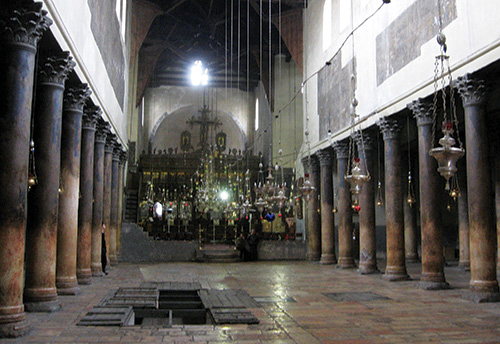
Still standing today, although it has been remodeled multiple times through history, the Church of the Nativity in Bethlehem was constructed around AD 327 to commemorate and preserve the location where Jesus was born. Yet this area was known as the site of the Nativity long before AD 327. The historical tradition appears to reach back into the first century, as by AD 135 the Roman emperor Hadrian had had a shrine to Adonis placed over this location in Bethlehem in an effort to paganize the site and obscure its historical connection to Jesus.5
Thus, even the Roman authorities recognized the significance and importance of Bethlehem as the place where Jesus Christ was born. No such archaeological site or historical tradition exists in Nazareth. What has been found in Nazareth are two first-century houses over which Byzantine-period churches were built to preserve and commemorate the childhood home of Jesus and the house in which Mary received the Annunciation.6
Quirinius & the Census
The census ordered by Augustus and administered by Quirinius is one of the two historical linchpins for understanding the timing and context of the birth of Jesus. According to Luke, a census for the Roman Empire was decreed, and it was for this reason that Joseph took Mary with him to Bethlehem.7 Contrary to popular perception, this empire-wide census was indeed recorded in official Roman records as one of three censuses which took place during the reign of Augustus. They numbered male Roman citizens at 4.063 million in 28BC, 4.233 million in 8BC, and 4.937 million in AD 14.8 The census which took place prior to the death of Herod the Great would have been the one ordered by Augustus in 8 BC. Joseph would have been required to participate and to go to his hometown of Bethlehem, as attested by Roman papyri which demonstrate that census demands involved summoning people to their hometowns for registration; that the summons involved even those who were not Roman citizens; and that, given the slow speed at which information traveled, the people might not even begin to respond to the order until a year after it had been decreed.9
According to Luke, Quirinius, who was a legate in Syria at the time, was the Roman official administering the census in Judea. A famous Roman aristocrat who is documented by ancient Roman writers and inscriptions, Publius Sulpicius Quirinius lived from 51BC to AD 21. He served as a commander of legions, a provincial governor, and a consul of Rome.10 One of his military deployments was a command which made him leader of multiple legions in Cilicia, Galatia, and Syria between 12 BC and AD 1 before he was appointed legatus propraetor (a governor appointed by the emperor) of Syria Province.11
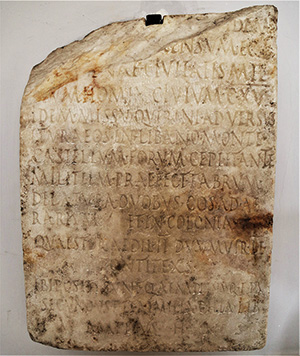
Roman protocol called for the military to administer censuses, and, significantly, Quirinius himself is mentioned as a legate in carrying out a census in Syria Province while Augustus was Caesar.12 An important inscription found in Beirut notes that P. Sulpicius Quirinius, a legate of Caesar in Syria, ordered an officer named Secundus to conduct a census of the city-state of Apamea, Syria. The inscription further describes how Quirinius and Secundus were involved in battling the Ituraeans on the mountain range known as Mount Lebanon, which is north of the Sea of Galilee and was part of the kingdom of Herod the Great.
Although this inscription and the census recorded by Luke have been erroneously connected to a regional tax assessment and acquisition of money from the deposed Herod Archelaus in AD 6, neither this inscription nor the census as mentioned by Luke describes a mere localized tax assessment.13 In fact, Luke specifically writes that the decree called for a census to be taken of the entire Roman world, while the records of Augustus also specify a census of the whole Roman Empire.14 Therefore, the census overseen by Quirinius and mentioned in this Beirut inscription was quite plausibly part of the census of the Roman Empire that was ordered in 8 BC and that eventually reached Judea just before the birth of Jesus.
Further, Tertullian (ca. AD 155–220) wrote that Sentius Saturninus, the governor of Syria Province from 9–6 BC, oversaw a census ordered by Augustus which took place in Judea around the time of the birth of Jesus.15 Justin Martyr even mentioned Quirinius as a procurator in Judea who carried out the census when Jesus was born.16 The apparent dilemma of both Quirinius and Saturninus being mentioned as rulers in Syria and connected to this census may be solved by understanding that Quirinius was a military legate and Saturninus was the governor of the province. Josephus also remarks that there were multiple governors or rulers of Syria Province while Saturninus was in power.17 This places Quirinius in the area of Syria and Judea around 8–7 BC as a military commander who would have been in charge locally of carrying out a portion of the empire-wide census ordered by Augustus.
As It Is Written
When collected and analyzed, all of the data indicate that Augustus initially ordered a census of the empire in 8 BC; that Quirinius carried it out in Syria and Judea while Saturninus was governor; and that Joseph and Mary eventually received word in Galilee, prompting their trip south to complete the registration; and finally, that Jesus was born in Bethlehem in approximately 7 BC, about a year after the initial order. Contrary to the claims of numerous skeptics and critics, the archaeological finds demonstrate that Jesus was born in Bethlehem and that there was an empire-wide census ordered by Augustus and administered by Quirinius in conjunction with this event.
Notes
1. Matthew 2:1–15; Luke 2:1–7.
2. E.g. Steve Mason, “O Little Town of … Nazareth?” Biblical Archaeology Review 16:1 (2000); Mark Smith, “Of Jesus and Quirinius.” The Catholic Biblical Quarterly Vol. 62, No. 2 (2000); Bart Ehrman, Jesus, Interrupted: Revealing the Hidden Contradictions in the Bible (2010).
3. A few scholars have argued that Herod did not die in 4 BC, but in 1 BC. However, the 1 BC theory contradicts information in Josephus, Herodian coinage, the lengths of the reigns of Herod’s sons, and the census of Augustus.
4. Justin Martyr, First Apology 1.34; Origen , Contra Celsus 1.51.
5. Titus Kennedy, Excavating the Evidence for Jesus (2022); Joel Kramer, Where God Came Down: The Archaeological Evidence (2020).
6. Matthew 2:23; Luke 2:39; Ken Dark, “The Byzantine Church of the Nutrition in Nazareth Rediscovered,” Palestine Exploration Quarterly 144 (2012); Titus Kennedy , Excavating the Evidence for Jesus (2022).
7. Luke 2:1–5.
8. Res Gestae Divi Augustus 8.
9. British Museum papyrus 904; Oxyrhynchus papyrus 255; P. Mich. 176–180; Sabine Huebner, Papyri and the Social World of the New Testament (2019).
10. Titus Kennedy, Archaeology and the People of the Bible (2026).
11. Tacitus, Annals 3.22–48; cf. Florus, Epitome of Roman History 2.31; Suetonius, Tiberius 49.
12. Lapis Venetus, Corpus Inscriptionum Latinarum vol. III, no . 6687.
13. Josephus, Antiquities 17.354, 18.1–102.
14. Luke 2:1.
15. Tertullian, Adversus Marcionem 4.19.
16. Justin Martyr, First Apology 1.34.
17. Josephus, Antiquities 16.280, 285, 357, 361, 17.89.
Titus Kennedy, PhD, is a field archaeologist who has been involved in excavations and survey projects at several archaeological sites in biblical lands, including directing and supervising multiple projects spanning the Bronze Age through the Byzantine period, and he has conducted artifact research at museums and collections around the world. He is a research fellow at the Discovery Institute, an adjunct professor at Biola University, and has been a consultant, writer, and guide for history and archaeology documentaries and curricula. He also publishes articles and books in the field of biblical archaeology and history, including Unearthing the Bible, Excavating the Evidence for Jesus, and The Essential Archaeological Guide to Bible Lands.
Get Salvo in your inbox! This article originally appeared in Salvo, Issue #75, Winter 2025 Copyright © 2026 Salvo | www.salvomag.com https://salvomag.com/article/salvo75/once-upon-a-time-in-bethlehem


